From Professional Development to Classroom Practice: Bringing Digital Education Labs to Life
Providing schools with innovative learning spaces and digital equipment is only the first step. The real challenge is helping teachers feel confident enough to use these resources with their students and integrate them into everyday teaching. This is where continuous professional development plays a crucial role.
This became particularly clear during the 50-hour professional development courses Digital Education Labs: Active Learning Scenarios, delivered across Portugal through School Association Training Centres (CFAEs). One example was the 50-hour course organised by the Sá de Miranda Training Centre in Braga, which ran from March to June 2026. It brought together teachers from several schools and a wide range of subject areas, including Science, Mathematics, Visual Arts, ICT, Music and Music Education.
Most participants joined the course expecting to develop technical skills by learning how to use the equipment available in the Digital Education Lab, including 3D printers, micro:bits, robotics kits and multimedia tools. As the course progressed, however, many realised that it was about much more than learning to operate new equipment. Designing learning scenarios inspired by the Future Classroom Lab approach encouraged teachers to create student-centred activities that combined different learning spaces, digital tools and teaching strategies while remaining firmly connected to the curriculum.
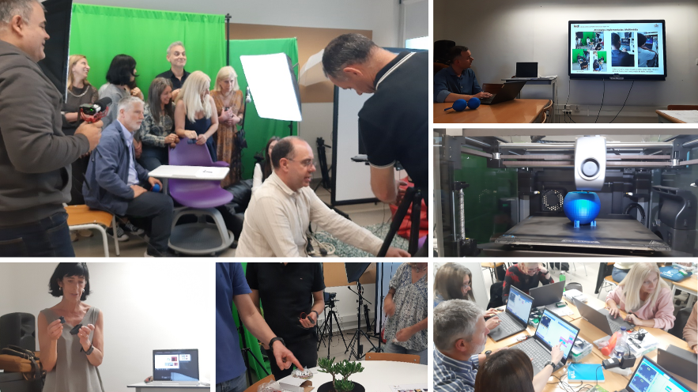
The course adopted a fully hands-on approach. Teachers designed and printed 3D objects, programmed micro:bit sensors, experimented with robotics, produced videos using teleprompters and chroma key, and explored the possibilities offered by a multimedia studio. Just as they would later expect from their students, participants learned by experimenting, solving problems, collaborating and creating. As one teacher reflected:
"The course went far beyond theory. We had to create real scripts and write real code, which meant getting our hands dirty – exactly what we want our students to do."
One aspect made a particularly strong impression: the training took place inside an actual Digital Education Lab at Dr. Francisco Sanches School. Rather than imagining how these resources might be used, teachers explored the different learning zones, experimented with the equipment and discussed how each space could support different types of learning.
Throughout the course, every participant designed a learning scenario for their own students. These scenarios combined activities taking place in the classroom, the Digital Education Lab and, in some cases, outdoor learning environments, showing how different learning spaces can complement one another. This helped teachers see that the Digital Education Lab is not intended to replace the classroom. Instead, it extends learning opportunities by creating new contexts for investigation, creativity, communication, collaboration and presentation.
Working directly with the equipment also increased teachers' confidence. Several participants admitted that they had never used many of these technologies before and were starting almost from scratch. By experimenting with the resources and designing activities for their own students, they began to see practical ways of using the Lab within their own teaching.
As one participant observed:
"Moving learning beyond the traditional classroom into a laboratory – which can become part of everyday school life – encourages teamwork and more active interaction between students. In the long term, it has the potential to transform teaching and learning practices, and ultimately the way we experience school."
Many teachers began applying their ideas immediately, while others designed new learning activities to use with their students in the following school year. In Visual Arts, students explored the relationship between three-dimensional objects and two-dimensional representation. After sketching ideas, they modelled their designs in Tinkercad, printed them using a 3D printer and then used the finished objects to develop technical drawing skills through orthographic projection. In Portuguese, students used the micro:bit to create interactive poetry. By programming the device to randomly combine words from different lexical categories, they explored vocabulary, creativity and poetic language in a playful and engaging way. Another learning scenario used robotics to explore astronomy, with students programming a robot to navigate the constellation of Hercules, stopping at each star to reveal information such as its name, colour, temperature and distance from Earth. Coloured leds and sound effects further enriched the experience by representing different stellar characteristics. In another Science scenario, students took on the role of science communicators, using teleprompters and chroma key technology to create news reports, documentaries and virtual field reports, combining scientific understanding with communication and digital literacy skills. These are just a few examples of the many ideas and learning scenarios developed throughout the course, illustrating the wide range of ways in which Digital Education Labs can enrich teaching and learning across different subjects.
More importantly, teachers who had already begun implementing these approaches in their classrooms reported a clear impact on students' engagement and learning. As one participant observed after putting these ideas into practice:
"The results were extremely positive. Students showed high levels of motivation, curiosity and engagement throughout the activities."
By the end of the course, participants were no longer thinking primarily about the equipment itself. Instead, they were thinking about the learning experiences they could create for their students. For many, the greatest value of the programme was not learning how to use new technologies but discovering meaningful ways to integrate them into everyday teaching. The Digital Education Lab was no longer seen simply as a room full of unfamiliar equipment. It had become a learning environment where technology serves clear educational purposes and supports meaningful, curriculum-based learning.
Author: Ana Alves
Useful links
Digital Education Labs: Active Learning Scenarios – CFAE Sá de Miranda (course featured in this article) https://www.cfsm.pt/course/5358
LED Learning Scenarios – Digital Education Labs (Portuguese Directorate-General for Education)
https://led.dge.medu.pt/cenarios-de-aprendizagem
Digital Education Labs – National LED Portal
https://led.dge.medu.pt
Future Classroom Lab – Create Zone
https://fcl.eun.org/create