Integrative STEM in Contemporary Elementary Education: A National Initiative Concludes Its First Year
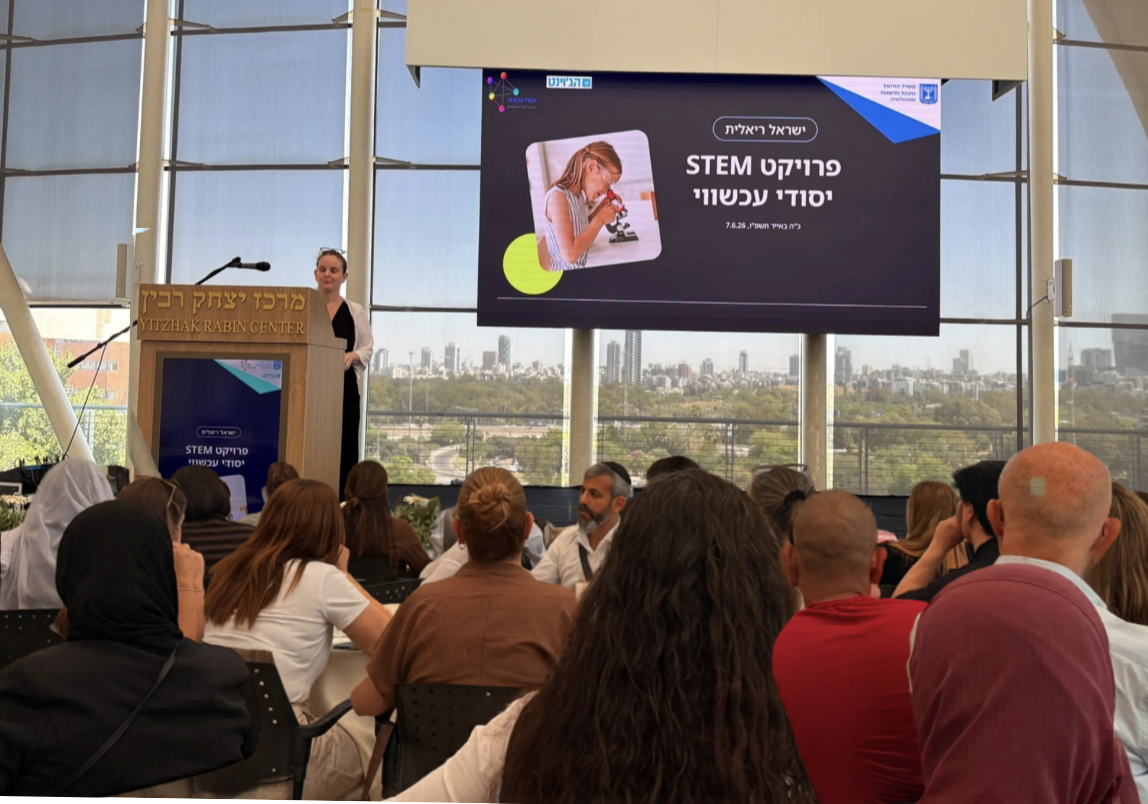
On June 7, 2026, educators, school leaders, principals, supervisors, headquarters staff, and partners from across Israel gathered at the Yitzhak Rabin Center in Tel Aviv to mark the conclusion of the first year of the “Contemporary Elementary STEM” initiative, a national effort led by the Elementary Education Division in collaboration with the R&D Unit of the Innovation and Technology Administration at the Ministry of Education.
The initiative seeks to reimagine STEM learning in elementary schools through an integrative, relevant, and future-oriented approach, connecting scientific and technological knowledge with real-life contexts, community challenges, and emerging global trends.
Its scale reflects both strong demand and deep impact: more than 570 schools applied to the open call, of which 116 were selected, representing a wide geographic spread from Majdal Shams in the north to Yeruham in the south. Alongside this, the initiative reached hundreds of thousands of students and supported tens of thousands of educators in developing competencies in artificial intelligence and integrative STEM learning.
The event opened with welcoming remarks by Hanna Lalush, Head of the Elementary Education Division, who highlighted the connection between the Contemporary Elementary approach and the vision of Integrative STEM. A key part of the event was the presentation of insights and data from the year’s activities by Dr. Ayelet Gonen from the R&D Unit at the Ministry of Education, showcasing both the breadth and depth of the work carried out in schools. The projects explored a wide range of themes, including sustainability, smart agriculture, renewable energy, digital technologies, inclusion, entrepreneurship, and community-based problem solving, reflecting a rich and diverse interpretation of integrative STEM learning. Many of these initiatives were rooted in authentic, real-world challenges drawn from students’ immediate environments—demonstrating a powerful shift toward learning that is relevant, inquiry-based, and connected to everyday life.
The event program included a keynote lecture by Dr. Yael Tsuri from the R&D Futures Institute titled “Children from the Future: How to Teach What Doesn’t Have a Name Yet?”. Dr. Tsuri challenged educators to rethink the purpose of education in an era shaped by rapid technological change. She addressed the emerging “Beta Generation”, learners growing into a world increasingly influenced by artificial intelligence and intelligent systems, and emphasized the need to move beyond teaching technology as a tool. Instead, she called for preparing students to navigate, question, and shape a complex and evolving reality, developing not only STEM literacy but also agency and resilience.
Following the plenary sessions, the event transitioned into a rich and diverse poster exhibition, where each school showcased the STEM initiatives it had explored throughout the year. This central space became a dynamic arena for professional dialogue, enabling educators to exchange ideas and learn directly from one another’s experiences.
Participants then returned to the main hall for a structured peer-learning session centered on roundtable discussions. In these mixed groups, schools engaged with peers they had not previously met, introducing themselves, presenting their initiatives, and reflecting on both strengths and challenges. The discussions also encouraged participants to share inspiring projects they had encountered during the poster exhibition, highlighting ideas that could be adapted to their own contexts.
The event concluded with a moment of recognition, as certificates were awarded to participating schools for their commitment to innovation and their contribution to shaping new models of learning. Beyond this formal closing, the atmosphere was distinctly forward-looking. The reflections shared throughout the day emphasized that this first year represents only the beginning of an ongoing journey—one characterized by continued experimentation, growth, and refinement. The work generated an ongoing stream of ideas, experiences, and possibilities, opening pathways for further development and expansion. The next phase of the “Contemporary Elementary STEM” initiative is already on the horizon, aiming to deepen integration, expand participation, and further align learning with the demands of a rapidly changing world. More details about its continuation are expected to be shared in the near future.
Author: Karina Batat