Preparing Today's Students for Tomorrow's Workforce: Petah Tikva's Groundbreaking "Who Am I in My Future" Program
In an era where the job market evolves at breakneck speed, one Israeli city is taking a revolutionary approach to preparing its students for careers that may not even exist today. Petah Tikva's innovative "Who Am I in My Future" program represents a paradigm shift in education, one that bridges the gap between classroom learning and real-world professional skills.
A City-Wide Commitment to Student Success
"Who Am I in My Future" is more than just another educational initiative; it's a groundbreaking program that introduces 10th-grade students to the skills that will define tomorrow's workforce. What makes this program truly remarkable is its scope and commitment, every single 10th grade class in Petah Tikva participates, reflecting the city's collective responsibility for its students' futures.
This comprehensive approach ensures that no student is left behind as they navigate the transition from traditional academic learning to the dynamic, skills-based economy that awaits them beyond graduation.
The Innovation House Ecosystem in Action
The program exemplifies the Innovation House's unique ecosystem by seamlessly integrating three critical worlds: industry, employment, and education. This trilateral collaboration creates an authentic learning environment that mirrors real-world professional dynamics.
The partnership brings together Petah Tikva Innovation House - providing the innovative framework and vision, The Pilat Group - a renowned investment house for human capital, contributing expertise in assessments and diagnostic solutions and City's Secondary Education Department - ensuring educational standards and implementation.
This collaboration ensures that students receive exposure to cutting-edge industry practices while maintaining rigorous educational standards.
Personalized Skills Mapping for the Future: At the heart of the program lies a sophisticated assessment tool—a specialized questionnaire developed by Pilat in collaboration with Professor Pasig. This isn't just another standardized test; it's a forward-looking diagnostic that helps students understand their potential in tomorrow's job market.
The process is elegantly simple yet profoundly insightful: students complete a targeted questionnaire, upon completion, they immediately receive a "Personal Future Skills Map" via email and skills are rated on a scale of 1 to 3, providing clear, actionable feedback (see image below).
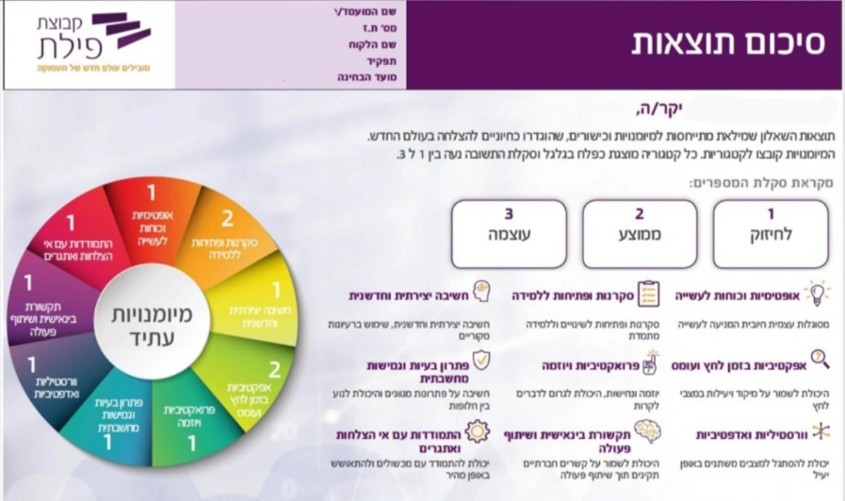
Personal Future Skills Map
This immediate feedback loop empowers students to understand their strengths and identify areas for growth, creating a personalized roadmap for skill development.
Real-World Experience Through Immersive Stations
Beyond assessment, the program offers hands-on experience through carefully designed stations that simulate authentic workplace scenarios. These experiential learning opportunities bridge the gap between theoretical knowledge and practical application.
One standout example is the Podcast Station, where students engage in content creation, broadcasting, and meaningful dialogue about topics that matter to them. This experience goes far beyond technical skills—it cultivates self-expression, modern communication abilities, and the confidence to share ideas in professional settings.
These stations expose students to diverse professional environments, helping them discover potential career paths while developing transferable skills that will serve them regardless of their chosen field.
A Model for Educational Innovation: Petah Tikva's "Who Am I in My Future" program represents more than local educational reform—it's a blueprint for how cities can take proactive responsibility for their students' career readiness. By connecting education directly to industry needs and future workforce demands, the program ensures that students graduate not just with diplomas, but with the practical skills and self-awareness necessary for professional success.
As the job market continues to evolve rapidly, programs like this demonstrate how forward-thinking communities can prepare their young people not just for today's opportunities, but for the careers of tomorrow. In Petah Tikva, the future isn't something students wait for, it's something they actively prepare for, one skill at a time.
Author: Karina Batat
